Van Bourgondien

Garden Guide Planting Roses & Shrubs

Your Shopping Cart is Empty

You can add items to your cart by browsing our store or see some of our best selling products

Choosing the Site

Roses require full sun, at least eight hours a day, preferably in the afternoon. Choose an open site where breezes will blow through the foliage. This will aid in drying the foliage, preventing many fungal and viral diseases. Ideally roses should be planted away from other trees and shrubs that compete for water and nutrients. Take note of the mature size of the rose or shrub, and allow room for growth. Snow provides excellent insulation for even the most tender plant, so consider a spot where snow may gather naturally. The site should be well-drained. If water tends to puddle in the area, either choose a different site, or raise the bed by at least 2" by adding organic matter.

The Soil

Roses and most shrubs like a rich, loamy soil. Loamy soil is basically a good combination of sand, clay, organic matter, and silt. Ensure that soil is not too high in any one of these components. Most commonly, soil may be too high in clay. In this case, add 1/3 by volume (1⁄2 by volume in extremely heavy clay soils) of humus material such as compost, peat moss, leaf mold, or well-rotted manure. A yearly application of a top dressing of well-rotted manure or kitchen compost is advised. Soil should be only slightly acidic, about pH 6-6.5. If soil is alkaline, use peat moss as humus material. If pH is below 5.5, use something other than peat moss as humus material, and condition soil with lime at a rate of up to 5lbs/100ft2 Some shrubs require different pH levels. Please check individual listings.

Pre-Plant Pruning of Bare-Root Roses

A hard pruning of bare root roses helps to concentrate the roses, energy on growing new shoots. First, prune all stems down to about 6-8" The cuts should be made at an outward facing bud; the buds will appear as small bumps that unfurl into leaves (not the thorns!) Find a bud that is on the outside of the shrub, facing away from the center. This is where new growth will emerge, ensuring that the rose will grow outward leaving an open center. Cut just above the bud, on a slight diagonal. Now, look closely at the center of each stem, called the pith. It should be quite white or green. If it appears dark or yellow, continue pruning down to outward facing buds until white pith is reached. There may be one or more dead stems; do not worry. Remove them and more energy will be put into the remaining stems. Now look for stems that may be rubbing against one another. The weaker of the two should be removed. Prune root tips back to white tissue to encourage branching.

Pre-Plant Pruning of Bare-root Shrubs

Before planting shrubs, any broken or damaged branches can be removed. If two stems are rubbing together, remove the weaker one. Prune root tips back to white tissue to encourage branching.

Planting

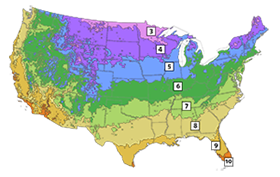
Dig a hole that is about 18"x18" or at least 6" wider and deeper than the roots themselves. Sometimes roots will grow only in one direction, so dig an oval shaped hole to suit. Dig a round hole if roots spread in all directions. Mix in some organic matter with the soil from the hole. A handful of bone meal will aid in root development. Lay a stick across the hole to determine exactly where the surface level will be. Make a small mound of soil on which to sit the rose and spread out roots, combing out the roots with fingers to keep them from crossing. Place the rose so that the bud union is 4" below soil level in zones 1-3, 3" below the soil in zone 4, and about 2" below the soil in zones 5+. This is approximate; generally, the harsher the climate, the deeper the bud union should be buried.

NOTE: Leaving the bud union exposed will produce more growth during the growing season. If the bud union is left exposed, the graft must be burried by mounding soil up over it in late fall. (Most shrubs are not grafted. In this case, just plant the crown, the spot where the roots meet the stems at ground level)

Fill the hole about 2/3 full. Use feet to pack down soil and water. After water has soaked in, fill hole and repeat packing and watering. This will ensure that there are no air pockets around the roots. Create a 'catch-basin' around the edge of the hole to catch water. Water again the following day with a water-soluble 10-52-10 fertilizer (the high middle number aids Planting Roses &Shrubs Watering Roses require a lot of water. Reduce the need for water by mulching and making a 'catch-basin'. Once roses are established, only water during very dry spells. For the first year, a good rule of thumb is about one gallon per foot per week. Roses that are dry heading into the winter will not fare out very well. Give a good soaking about 2-4 weeks before the ground freezes. It is better to give infrequent, deep watering than frequent, light watering. Avoid getting water on the leaves. Dry leaves prevent the spread of viral and fungal disease. Water early in the morning to allow the leaves to dry off before evening. Most shrubs benefit from receiving at least 1" of water per week during the first season. Once established, most shrubs are quite drought tolerant, but are more productive and healthier if watered during dry spells. in root development), or water with manure or compost tea. Mulching halfway up the stems for the first couple of weeks will prevent drying out. Water and fertilize this way once a week for the next three weeks.

Sweating Roses after Planting

Important! Roses are best planted in early spring when it is still cool. If roses are received when daytime temperatures are consistently above 60ºF, follow these guidelines. If it is still cool, leave the graft union exposed so that warmth can help buds break. Whatever the temperature, plant as soon as possible.

Bare-root roses are dormant when shipped, and they must be protected from drying out until the roots become established. The greatest danger of drying, and thus dying, occurs during warm sunny weather. Therefore, it is necessary to completely cover the exposed canes with a mound of loose organic mulch, wood shavings, compost, peat moss, or sphagnum moss after planting. This is called 'sweating' your roses and is especially important if it is already very warm when the roses are received.

This covering will protect the canes from drying out while the roots are becoming established. In two to three weeks, sometimes longer, shoots will begin to emerge through the mounding material. It is then safe to gradually remove the mounding material by carefully pulling it away or by washing it away with a hose. Water newly-planted rose bushes often to ensure that they get a good start.

Many bare-root shrubs, such as Burning Bush, Lilac, Weigela, etc. can benefit from 'sweating', especially if your days are warm and sunny at planting time. It certainly would do no harm. You may have to remove the mound of material sooner, since shrubs often leaf out quickly.

Special Care for Tree Roses

Tree Roses often take extra time to leaf out after planting. It is important to prevent the top stems from drying out during this time. Placing a moist burlap sack over the branches will encourage bud break and prevent dehydration. Keep the sack moist and check often. Once leaves start to appear, remove the sack. If planting in pots, they should be at least 14" in diameter.

Items you have recently viewed

Recently Viewed Categories